
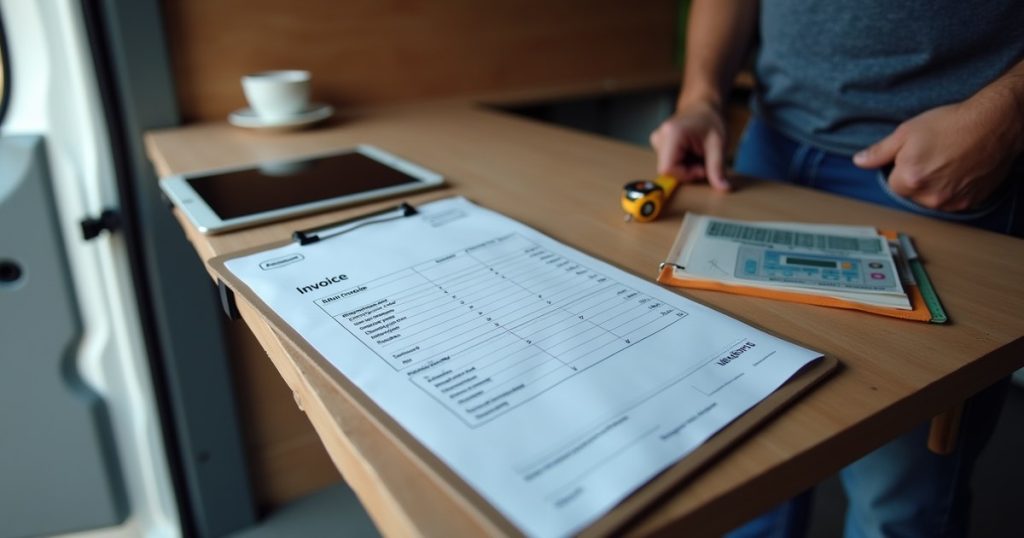
Free Invoice Template for Tradesmen and Contractors (With Example)
A tradesperson’s invoice should list your details, the customer and job address, an invoice number, itemised labour and materials, tax, the total and clear payment terms. Use the layout and worked examples below, or build one in two minutes with our free Invoice Generator, then send it the same day.
Affiliate Disclosure: This article contains affiliate links to FreshBooks. We may earn a commission if you sign up through our links, at no extra cost to you.
You did a great job. The tap stopped dripping, the lights work, the wall is straight. Then you send an invoice that says “Work done – £350” and your customer rings to ask what exactly they are paying for. Three weeks and two awkward phone calls later, you are still waiting.
Most trade invoice problems are not about greedy customers. They are about vague paperwork. A clear, itemised invoice answers the questions before anyone asks them, which means faster payment and fewer uncomfortable conversations. Here is a layout you can copy, two worked examples, and a handful of habits that make getting paid easier. If you would rather use software, see our roundup of the best invoice software for contractors and tradespeople.
What Goes on a Tradesperson’s Invoice
- Your details: business name, address, phone, email, and any licence or registration number your trade requires.
- Customer details and job address: the person paying may not live where the work was done, so include both.
- Invoice number and date: use a simple, consistent sequence. See invoice numbering best practices if you are unsure.
- Itemised work: split labour, materials and call-out or travel charges onto separate lines.
- Tax: add sales tax, VAT or GST if you are registered. See how to add tax to an invoice.
- Payment terms and methods: due date, bank details or a payment link, and what happens if payment is late.
Example 1: A Plumbing Repair (UK)
Figures are illustrative. Yours will vary by region and trade.
| Description | Qty | Rate | Amount |
|---|---|---|---|
| Call-out and assessment | 1 | £60.00 | £60.00 |
| Labour — replace mixer tap and seals | 3 hrs | £45.00 | £135.00 |
| Materials — mixer tap | 1 | £82.00 | £82.00 |
| Materials — seals, fittings, sealant | 1 | £18.50 | £18.50 |
| Subtotal | £295.50 | ||
| VAT at 20% (if registered) | £59.10 | ||
| Total due | £354.60 |
Example 2: An Electrical Job (US)
| Description | Qty | Rate | Amount |
|---|---|---|---|
| Service call | 1 | $85.00 | $85.00 |
| Labor — install two outlets and one GFCI | 2.5 hrs | $95.00 | $237.50 |
| Materials — outlets, GFCI, wire, box | 1 | $64.00 | $64.00 |
| Subtotal | $386.50 | ||
| Sales tax (where applicable) | Varies | ||
| Total due | $386.50 + tax |
Under either example, add a line such as: “Payment due within 14 days of invoice date. Bank transfer to [account details], or pay by card at [link]. Late payments may incur interest.”
Make This Invoice in Two Minutes
Our free Invoice Generator lets you add line items, tax and your logo, then download a PDF. No sign-up required.
Quote, Estimate, Invoice: What’s the Difference?
| Document | When You Send It | What It Does |
|---|---|---|
| Estimate | Before the job | A rough idea of cost; may change |
| Quote | Before the job | A firm price the customer can accept |
| Invoice | After (or during) the job | A request for payment for work done |
Keep the invoice consistent with what you quoted. If the final figure is different, add a short note explaining why. Surprises are what start disputes, and our guide on how to handle disputed invoices is there for when they happen anyway.
Seven Habits That Get You Paid Faster
- Invoice the same day. Memory fades and goodwill is highest right after the job.
- Take a deposit on bigger jobs. For anything with significant materials, use the approach in how to invoice for deposits and partial payments.
- Show materials separately. Customers accept material costs far more easily when they can see them.
- Take a quick photo of the finished work. Attach it to the invoice. It settles most “did you really do this?” questions in one glance.
- Confirm extra work in writing. A two-line text like “Found rotten boards, extra £120 to replace — OK to proceed?” saves a lot of grief.
- Make paying easy. Include bank details and, if you can, a card payment link. People pay faster when they do not have to hunt for how.
- Follow up politely. A friendly reminder a few days after the due date is normal, not rude.
UK Subcontractors: A Quick Note on CIS
If you work as a subcontractor under the Construction Industry Scheme, contractors may deduct tax from your payments at source. The deduction rate depends on your registration status. Show any deduction clearly on your invoice and keep records for your tax return. The rules are on GOV.UK, so check the current ones for your situation.
When to Move From a Template to Software
A template is fine while you send a handful of invoices a month. Once you are juggling deposits, repeat customers or chasing payments, software that sends reminders and tracks who has paid saves hours you would rather spend on the tools. Compare options in our guide to the best invoice app for the self-employed.
Frequently Asked Questions
What should a plumber’s invoice include?
Your business details, the customer and job address, an invoice number and date, itemised labour and materials, any call-out fee, tax if applicable, the total, and clear payment terms and methods.
Should I itemise labour and materials separately?
Yes. Separate lines make the invoice easier to understand and cut down on queries and disputes.
Can I charge for travel or call-out time?
Yes, if you have agreed it with the customer. Show it as its own line so it is transparent.
Is there a free invoice template I can download?
Our free Invoice Generator creates a PDF invoice with line items and tax in your browser, with no sign-up.
How soon after the job should I send the invoice?
As soon as possible, ideally the same day. Prompt invoices are paid faster than those sent weeks later.
Final Thoughts
A clear, itemised invoice sent promptly is one of the cheapest ways a tradesperson can get paid faster. Copy the examples above, take deposits on bigger jobs, show your materials, and make paying easy. Do that, and you will spend more time on the tools and less time on the phone asking where your money is.
Disclaimer: This article is for general information only and is not tax or legal advice. Tax and licensing rules vary by country and trade. Example figures are illustrative. Affiliate links are present in this article.